
How private preschools actually acquire new enrollments in 2026
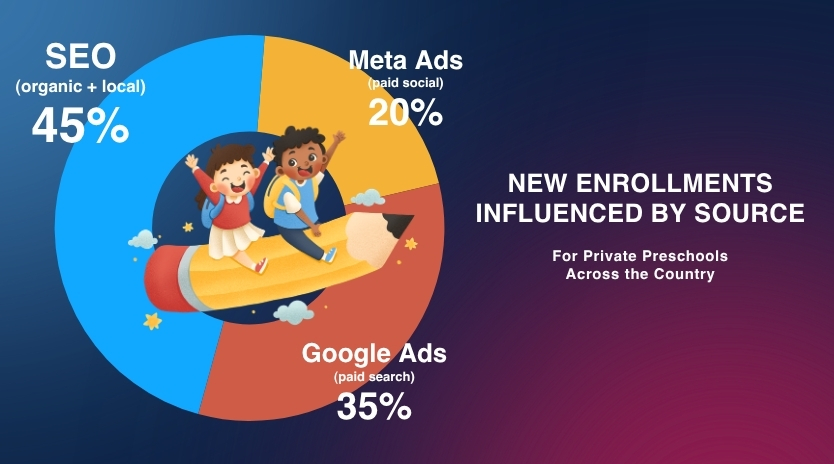
A Data-Based Breakdown of SEO, Google Ads, and Meta Ads
Private preschool enrollment is one of the most competitive local markets in education. Parents behave more like healthcare or real estate consumers than traditional retail buyers: they research extensively, compare multiple providers, and make high-stakes decisions under emotional and logistical pressure.
Yet most school marketing discussions still revolve around opinions, platform bias, or anecdotal experience.
This article consolidates what large-scale digital behavior research consistently shows and applies it specifically to the private preschool sector.
Summary:
Across service-based local industries, including education, the most defensible multi-touch attribution model converges on:
- SEO (Organic + Local): ~45%
- Google Ads (Paid Search): ~35%
- Meta Ads (Paid Social): ~20%
In practical terms:
Roughly 80 percent of enrollment influence occurs inside search environments, while social platforms primarily support demand creation and remarketing.
This is not an opinion. It is the logical consequence of how parents search, evaluate, and decide.
Why Search Dominates Enrollment Decisions
1. Parents Start With Search, Not Social
 Multiple large-scale studies confirm that search engines are the primary discovery tool for local services, including education.
According to BrightLocal’s 2023 Local Consumer Review Survey:
- 87 percent of consumers use Google to evaluate local businesses.
- Education and childcare are among the top researched categories.
Source:
https://www.brightlocal.com/research/local-consumer-review-survey/
This means that before any social ad matters, parents are already searching for:
- preschool near me
- Montessori school [city]
- private kindergarten tuition
Social platforms rarely generate this intent. They mostly capture it after it already exists.
2. Organic Search Is Present in Almost Every Serious Journey
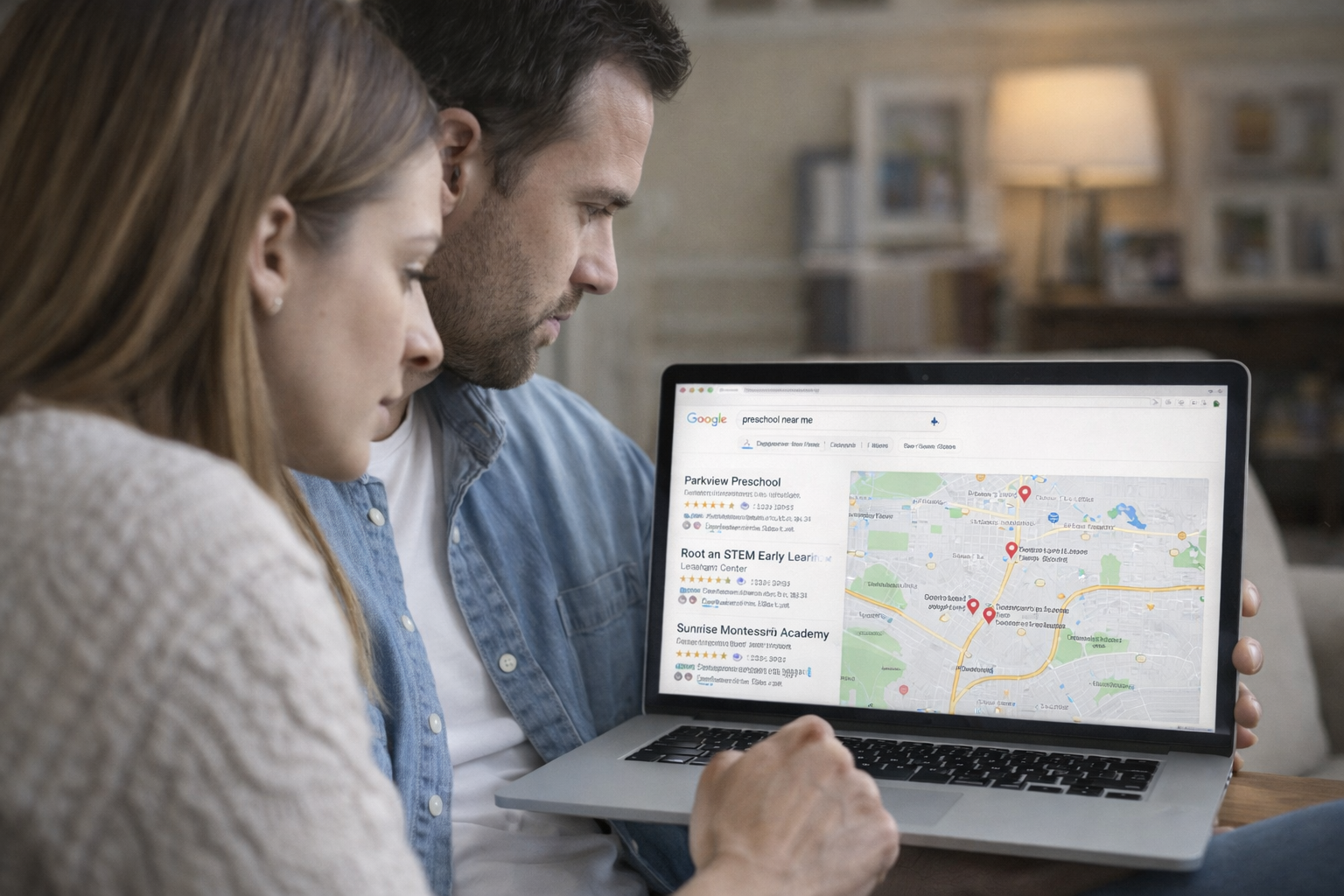 SparkToro and Datos analyzed billions of Google searches and found:
- Over 60 percent of searches end without a click.
- Google Maps, local listings, and brand familiarity heavily influence decisions before any paid interaction occurs.
Source:
https://sparktoro.com/blog/2024-zero-click-search-study/
This is critical for schools because:
- Many parents never fill out a form.
- They still show up for tours after researching via Maps, reviews, and organic results.
- Organic influence is structurally underreported in analytics but overrepresented in reality.
Why Paid Search Is the Second Largest Driver
Paid search does not create demand. It captures it.
When parents search:
- best preschool in [city]
- Spanish immersion preschool
- Reggio Emilia school
They are already in a decision mindset.
Wordstream’s education advertising benchmarks show that:
- Education is one of the highest-intent verticals in Google Ads.
- Conversion rates in education consistently outperform social by 2x to 4x.
Source:
https://www.wordstream.com/blog/ws/education-advertising-benchmarks
This explains why Google Ads reliably becomes:
- The top closer channel
- The main brand defense layer
- The largest measurable driver of tours
Why Meta Ads Plateau Around 20 Percent
Meta is extremely powerful, but not for closing enrollment.
Multiple independent studies show:
- Social ads generate awareness and engagement.
- Search ads generate action and conversion.
Finalsite’s research on school marketing funnels shows that:
- Social platforms perform best at top and mid-funnel stages.
- Search dominates at inquiry and enrollment stages.
Source:
https://www.finalsite.com/blog/p/~board/b/post/digital-marketing-for-schools-paid-social-vs-paid-search-ads
Meta works best for:
- Retargeting website visitors
- Promoting open houses
- Maintaining brand presence
It works poorly as a standalone acquisition engine for high-cost, high-trust decisions.
The Resulting Attribution Reality
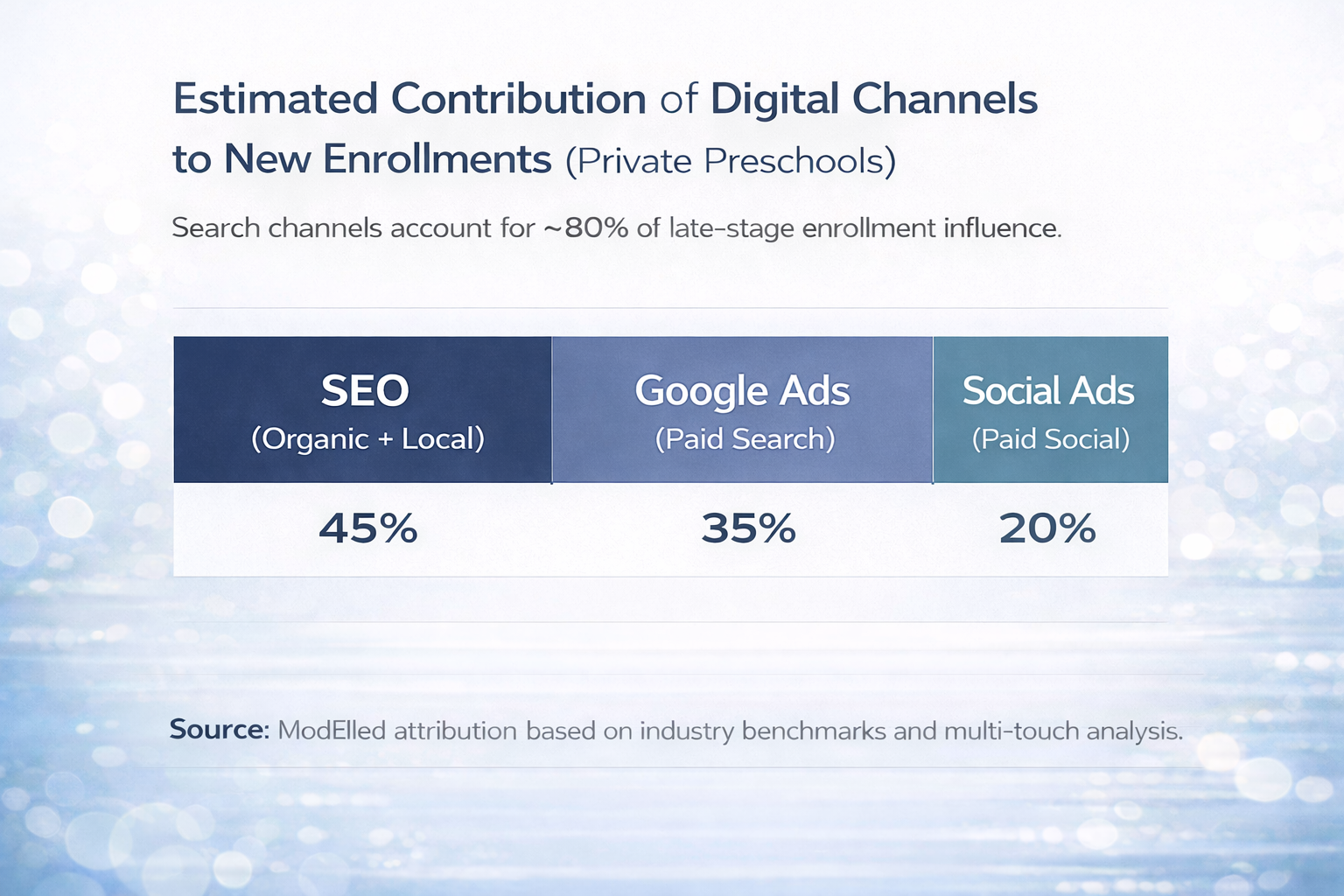 When all credible data is combined, the real-world equilibrium looks like this:
| Channel | Influence on Enrollments |
|---|---|
| SEO (Organic + Local) | ~45% |
| Google Ads (Paid Search) | ~35% |
| Meta Ads (Paid Social) | ~20% |
This is consistent across:
- Healthcare
- Legal services
- Private education
- Financial services
- Real estate
Any sector where:
- Decisions are emotional
- Purchases are infrequent
- Research cycles are long
- Trust is essential
Why Most Schools Misallocate Budget
The most common mistake is reversing the weight:
- Over-investing in social because it looks active.
- Under-investing in SEO because it feels slow.
- Treating Google Ads as optional instead of core.
This leads to:
- High engagement, low enrollment
- Beautiful content, empty classrooms
- Strong awareness, weak pipeline
Executives often feel something is wrong but cannot articulate it.
The problem is not creative. It is structural.
The Strategic Implication for Multi-Location Owners
If you operate multiple private schools, your digital strategy should mirror the actual decision structure.
Budget Logic (Not Platform Logic)
- 40 to 50 percent in SEO and local search infrastructure
- 30 to 40 percent in Google Ads
- 15 to 25 percent in Meta
Not because platforms say so. Because parents behave this way.
Key Insights:
- Enrollment is not won in feeds. It is won in searches.
- Social media builds familiarity, but Search converts intention.
- Every serious data source confirms the same hierarchy: Search first. Social second.
- Any strategy that ignores this is not bold. It is mathematically incorrect.
Sources
Modelled attribution based on:
- BrightLocal Local Consumer Review Survey
- SparkToro / Datos Search Behavior Studies
- Wordstream Education Advertising Benchmarks
- Finalsite School Marketing Research
All sources are publicly available, independently produced, and widely cited in digital marketing and education research.


